

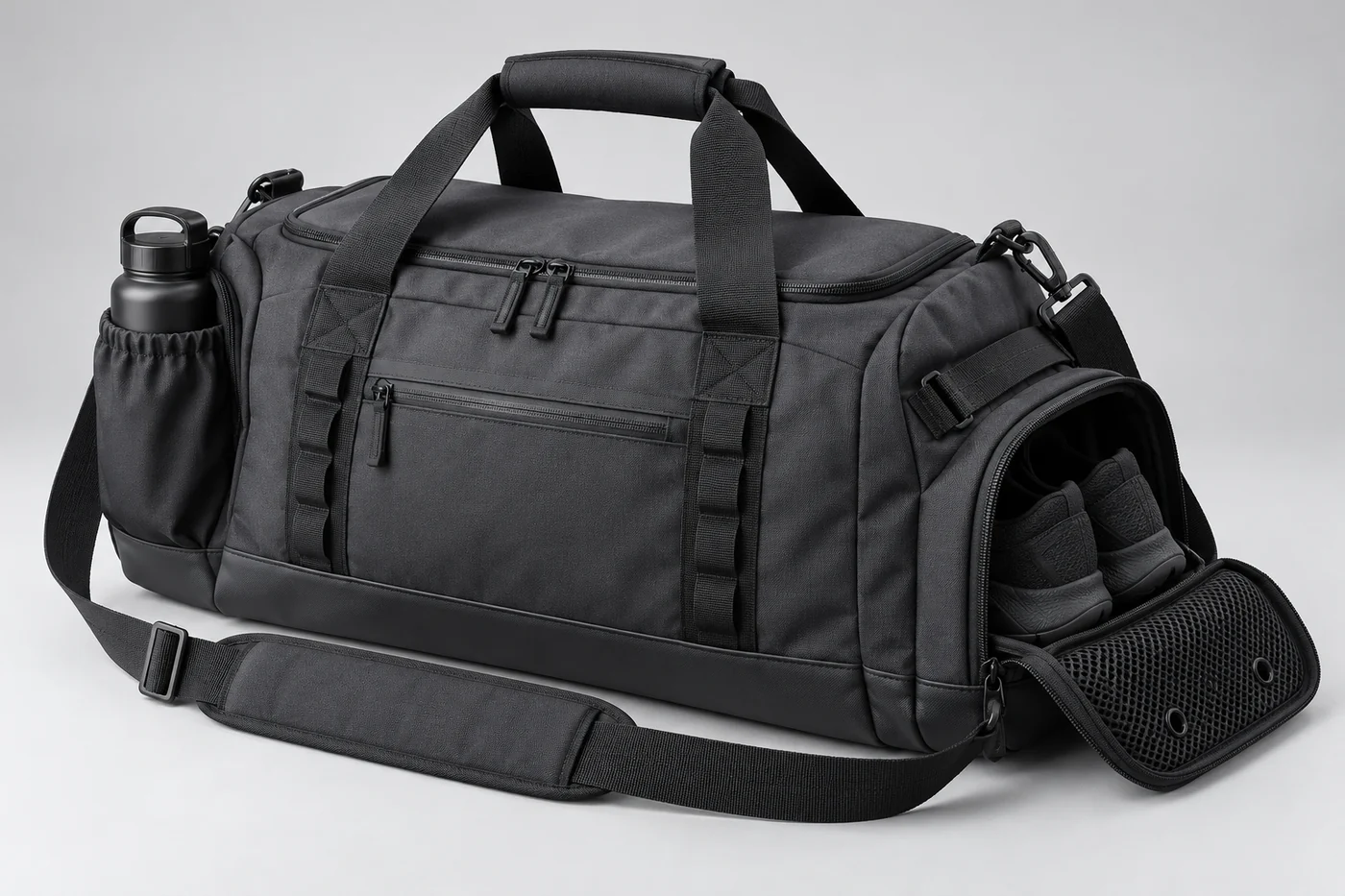
This article draws on three private development documents: a factory requirements sheet, an exterior layout drawing and a separate lifting-belt storage detail. Together they describe the requested bag and the questions a factory would need to resolve at sampling. The design has been anonymized and generalized here; the article does not report a completed prototype or test result.
1. Turn the equipment list into a buildable brief
The source brief names the load: a pair of lifting shoes, a lifting belt, wrist wraps or straps, knee sleeves, a shaker, chalk, valuables, sweaty clothing and a towel. It asks for a bag that holds its shape when empty, opens widely for packing and gives the damp or dirty items separate places. Those are useful starting points because each item affects pocket size, access and construction.
2. Give each piece of training gear a practical place
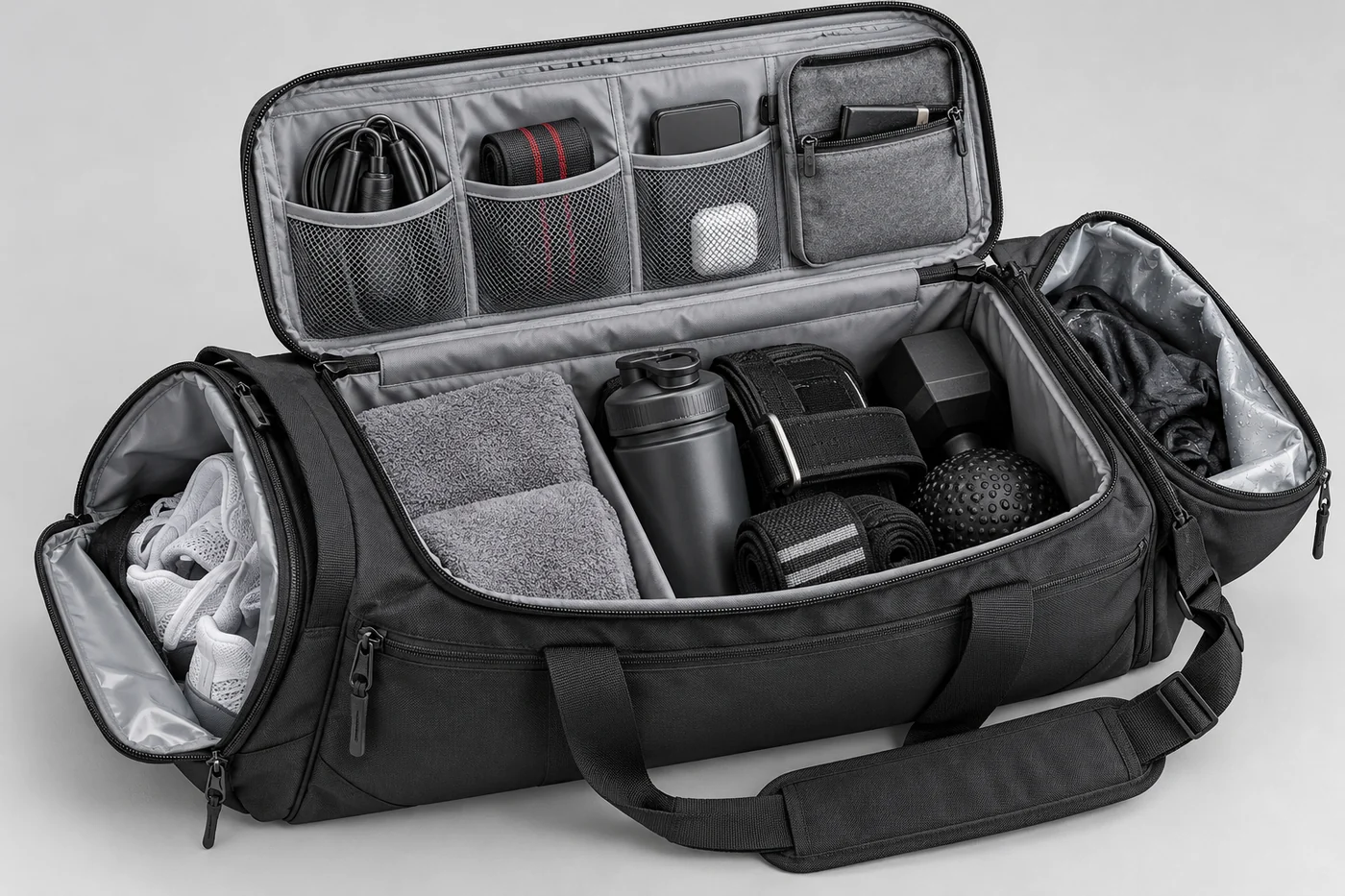
Main compartment and small-gear organizer
The brief calls for a wide clamshell opening and a light-colored lining. Elastic loops and mesh pockets are intended for wraps, straps, grips, a jump rope and knee sleeves; a key clip and valuables pocket keep smaller items separate.
End-access shoe compartment
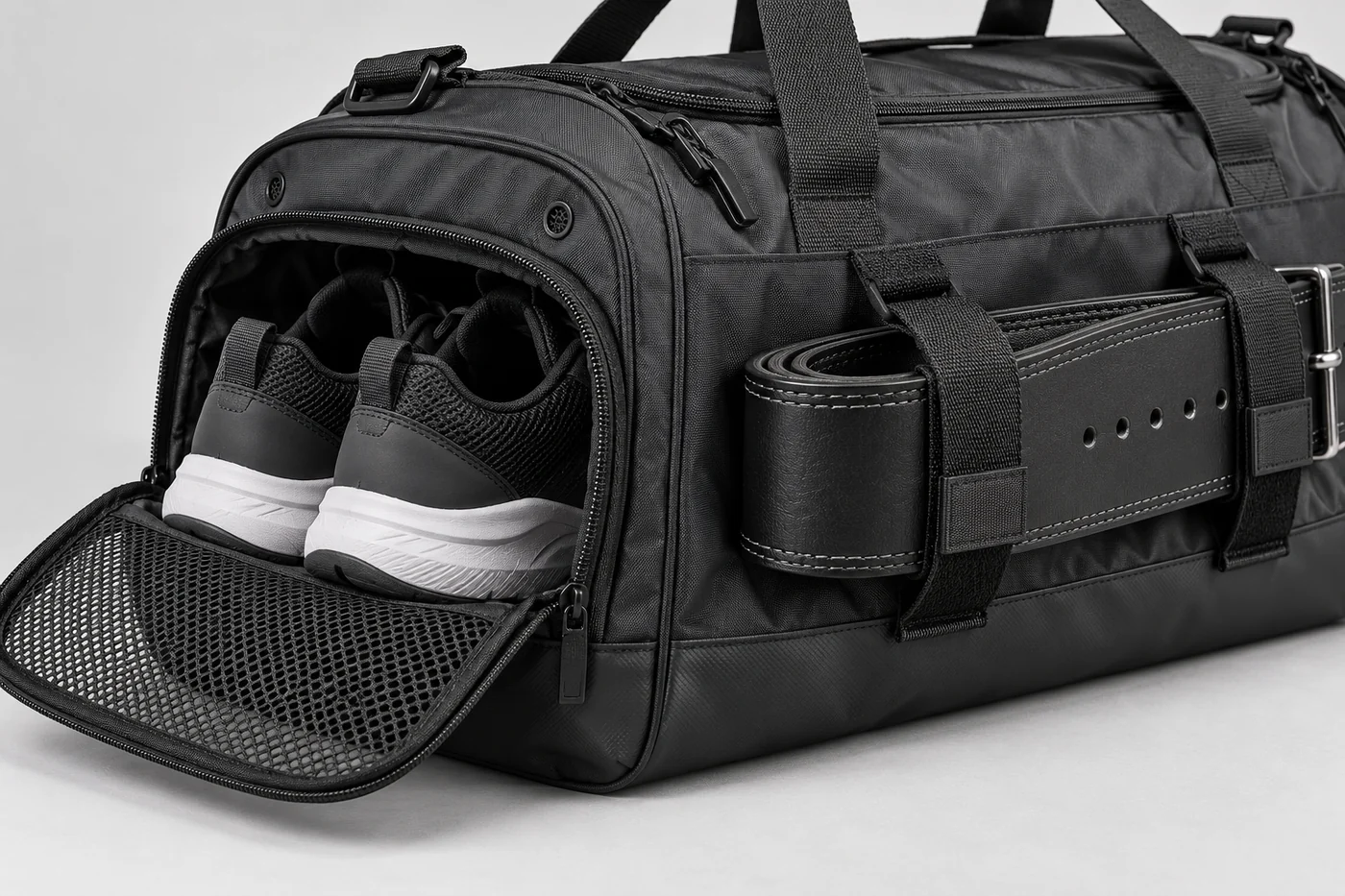
The proposed shoe zone has its own U-shaped opening, a wipe-clean lining and a mesh vent. The source specifically asks the factory to test a real pair of large lifting shoes and trainers in the first sample. A drawing alone cannot prove comfortable fit.
Separate sweaty-gear and chalk pockets
The requirements describe a zipped, TPU-lined space for sweaty clothes and a towel, plus a smaller wipe-clean pocket for chalk. Welded or taped seams and careful treatment of stitch holes are requested to help isolate moisture and chalk dust. Finished-bag performance still needs testing.
Keep the lifting belt outside the main load
One source drawing is devoted entirely to external belt storage. It calls for the belt to be retained along the outside of the bag, with its ends held apart from the main compartment and straps securing the exposed section. This public article omits the customer’s exact sleeve geometry and measurements.
The requirements also call for reinforcement at webbing anchors and closures that are easy to grip. The sample should be checked with an actual belt to confirm secure retention and access to the adjacent compartments.
| Zone | Requested function | Source-based construction direction | Sample check still needed |
|---|---|---|---|
| Main compartment | Pack the bag flat and see its contents | Wide clamshell opening with light lining | Opening, usable space and pocket access |
| Shoe compartment | Carry one pair apart from clothing | End opening, wipe-clean lining and mesh vent | Fit with real lifting shoes and trainers |
| Sweaty-gear pocket | Isolate damp clothes and a towel | Separate zipped TPU-lined compartment with controlled seams | Cleanability and moisture transfer |
| Lifting-belt carry | Store a bulky belt outside the main space | External retention with reinforced webbing closures | Belt fit, security and access to other pockets |
| Small-gear organizer | Separate wraps, straps, grips and sleeves | Elastic loops, mesh, valuables pocket and key clip | Real-item fit and reach |
| Chalk pocket | Contain chalk dust | Small zipped wipe-clean pocket | Closure and seam containment |
| Quick-access top pocket | Reach a phone or glasses without opening the bag | Soft-lined zipped pocket | Reach and zipper clearance |
| Bottle pocket | Hold a shaker upright | Gusset and reinforced or elastic top edge | Shaker fit and retention |
3. Match each material to its compartment and load
The factory sheet gives material options rather than a confirmed production bill of materials. The public summary below retains the common fabric classes and construction choices while omitting supplier proof, color references and client-specific commercial requirements. Every choice still needs a sample and final approval.
| Component | Direction stated in the brief | Intended use | What remains to confirm |
|---|---|---|---|
| Outer shell | Coated 500D nylon, with a standard-nylon alternative | Structured outer body | Actual hand feel, coating and abrasion performance |
| Main lining | Light-colored 210D ripstop nylon | Visibility inside the main compartment | Color, coating and sewing behavior |
| Wet and chalk zones | TPU-coated, wipe-clean lining and controlled seams | Contain damp kit or chalk separately | Seam method and finished-pocket performance |
| Base | Reinforced nylon, or foam support beneath the shell | Shape retention and floor-contact protection | Stiffness, abrasion and seam placement |
| Handles and strap | High-tenacity nylon webbing with EVA padding | Comfort and load transfer | Anchor construction and carrying comfort |
| Zippers | Larger coil zippers for the main opening; smaller ones for pockets | Match zipper strength to the opening | Smooth travel and end reinforcement |
| Attachment hardware | Powder-coated metal or molded polymer options | Detachable shoulder strap and closures | Fit, finish and strength on the sample |
The brief asks for water-resistant construction in selected areas. Coated nylon and a TPU-lined pocket do not establish that the finished bag is waterproof. Any public performance claim should follow a test on the approved construction.
4. Resolve the open questions in a physical sample
Test real equipment fit
Place lifting shoes, a belt, a shaker and the listed accessories in the sample. The brief explicitly requests a real-shoe fit check.
Check compartment interaction
Confirm that the shoe zone, wet pocket and belt carry do not obstruct one another or remove too much usable main space.
Inspect reinforced anchors
Review handles, shoulder hardware and external webbing. The construction sheet asks for reinforcement at load-bearing attachment points.
Review internal seams
Check bound or taped edges, the shoe-compartment seams and the wet pocket’s lining for unwanted stitch holes.
Run every closure
Confirm that all zippers move smoothly from end to end and that the belt closures can be operated with damp or chalky hands.
Record the approved build
After revisions, document the selected materials, pocket positions and accepted construction details for production.
Frequently asked questions
Why does the brief request a separate shoe compartment?
It keeps used footwear away from the main load. The proposed compartment has an end opening, wipe-clean lining and vent; the factory is asked to verify fit with real lifting shoes and trainers.
Where does damp training kit go?
The proposed layout gives sweaty clothes and a towel a separate zipped pocket with a TPU-coated lining and controlled seams. The finished sample must still be checked for moisture transfer.
Can the finished bag be called waterproof?
The documents specify selected water-resistant materials and a lined wet pocket, but contain no finished-product test result. A waterproof claim would require evidence from the completed construction.
How is a lifting belt kept out of the main compartment?
The design brief proposes external retention, with the belt secured along the outside of the bag. The sample needs a real-belt fit check and a review of webbing anchors and nearby pocket access.
Has this duffel been sampled or approved?
The documents are development and quotation requests. They ask a factory to confirm dimensions, pocket placement, material options and sample performance; they do not document an approved production bag.
Developing a custom gym or travel duffel?
Planning a gym or travel duffel? Send Liqibag an equipment list, compartment priorities and reference images to discuss materials, sampling and production requirements.
Based on an anonymized development brief. Images are AI-generated concepts; sample checks described here are proposed, not reported as completed.
 Custom Bible Bag Organizers & Bible Covers
 Backpacks & Drawstring Bags
 Cooler & Thermal Bags
 Cosmetic & Toiletry Bags
 Tote & Shopping Bags
 Tool, Medical & Equipment Bags
 Washable Kraft & Tyvek Bags
 Camera Bags & Photography Cases
 Crossbody & Shoulder Bags
 Pet Bags & Accessories
 Storage & Organizer Bags
 Travel & Duffel Bags